
The RELION MicroSampling Apparatus
Many users of Cathodoluminescence petrography often wish to sample regions of interest for various geochemical analyses (for example, stable isotopes or trace elements). Relion has developed a versatile micro-sampling apparatus, building on the work of Fouke, B.W. and J. Rakovan, 2001.
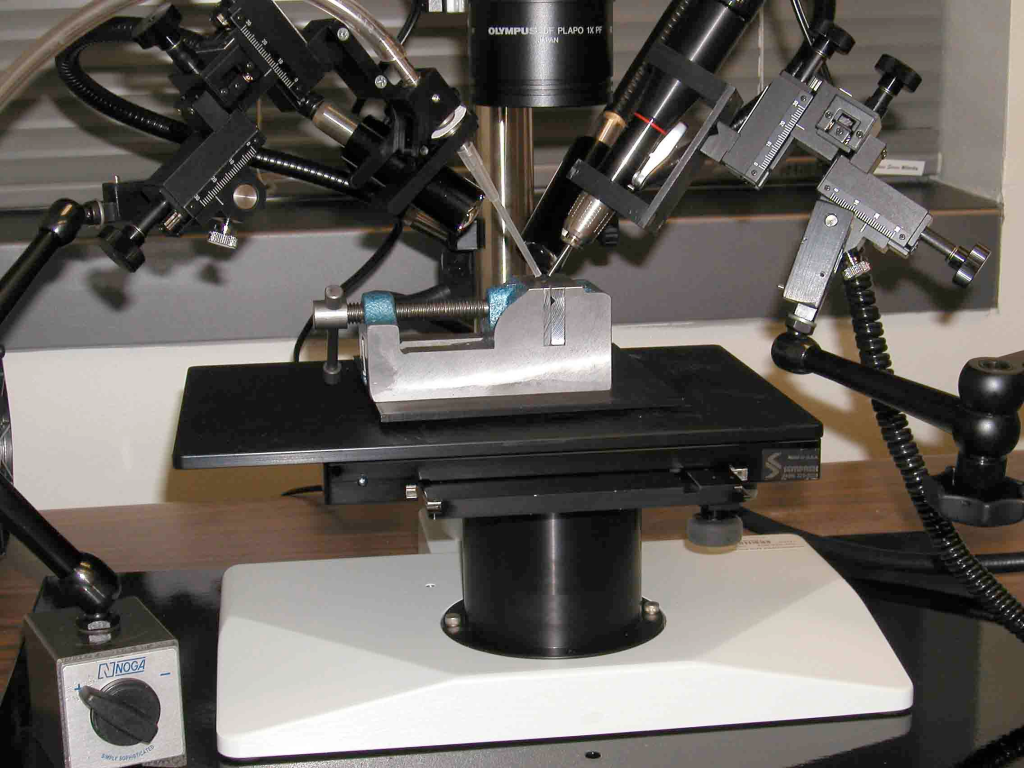
Microsampling may be done with either Microdrilling or Micromilling techniques.
In both cases, a vacuum-operated micropipette is used to collect the powdered material generated by the drilling or milling on a filter.
We are currently exploring micro-core drilling and "spallation" (production of chips as opposed to powder) techniques.
Each system is built to order, customized to the user's requirements, but each system typically incorporates the following major components :
User Requirements:
What type of material do you hope to sample with the Relion Micro-Sampling Appratus? For example, carbonate rocks, silicate rocks, or something else? Please describe.
In what "format" will the samples be presented? For example, standard petrographic thin sections (27x46 mm)? Thick sections? Large-format sections (2" x3")? Un-mounted cut pieces of rock (such as thin section blanks)? Or something else? Please describe.
What type(s) of analyses are you collecting the powder for? For example, stable isotope ratio measurements, or something elses? Please describe.
How much sample material does the analytical method(s) you intend to use require? either in volume or mass...
What is the scale of the typical type of features you are hoping to sample?
Are you selecting the features for sampling based on previously-obtained cathodoluminescence or other type of imaging?
If you are supplying the microscope and imaging system, we need to know the full details of what you are proposing to use, including the nature of your stage, lighting sources, objective working distance, camera and software capabilities (i.e., can it overlay the live video from the microscope camera with your previously-obtained CL or other guiding image?), etc...